India's First Unified National Membership Platform - India's FirMembership Platform - India's First National Membership Platform - India's First Unified National Membership Platform
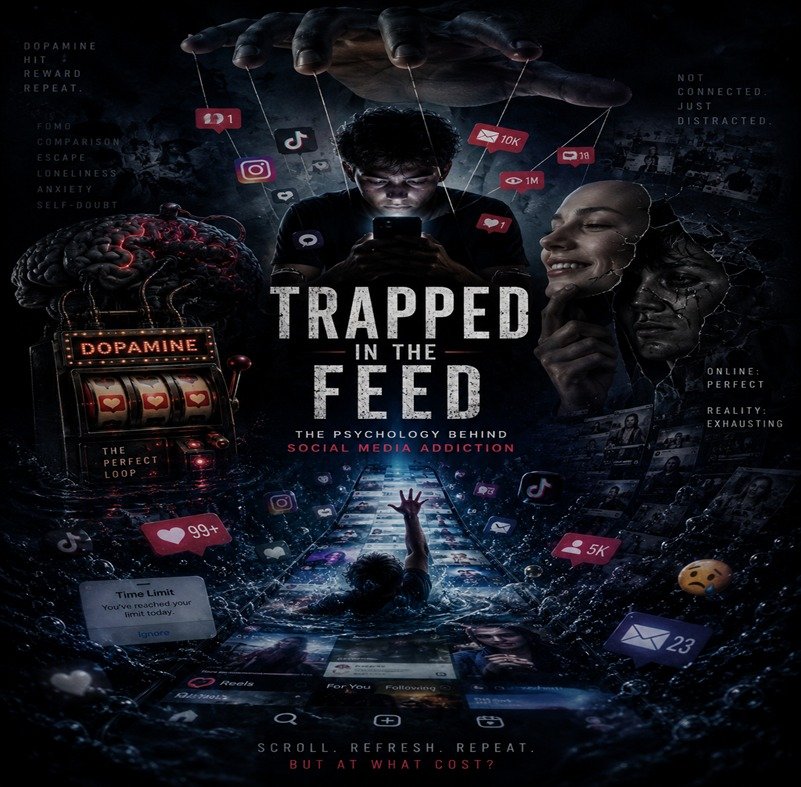
Trapped in Feed ??
The Psychology Behind Social Media Addiction
- Pratyusha Magdum
Just five minutes.
That’s what most people tell themselves before opening Instagram, TikTok, or YouTube.
Then suddenly, it’s been two hours, your battery is dying, and somehow you know the entire life story of a random stranger on the internet
Social media has become a huge part of modern life. It helps people connect, communicate, and stay updated with the world. But for many people, especially teenagers, social media slowly turns from entertainment into addiction.
Mind & Media
One of the biggest reasons behind this is dopamine,a chemical in the brain connected to pleasure and reward. Every notification, like, comment, or message gives the brain a tiny dopamine boost. It creates a feeling of excitement, making people want to check their phones again and again.
Apps are also designed to keep users scrolling for as long as possible. Features like endless feeds, autoplay videos, and personalized recommendations make it difficult for the brain to stop. There is always “just one more video” waiting.
Social media also affects emotions and self-esteem.
Seeing perfect photos, expensive lifestyles, and edited appearances online can make people compare themselves constantly. Over time, this can lead to stress, insecurity, anxiety, and the fear of missing out, also known as FOMO.
Another reason social media becomes addictive is because it gives people instant escape from boredom, loneliness, or stress. Instead of sitting alone with thoughts, many people immediately reach for their phones without even realizing it.
The scary part is that most people do not notice how much time they spend online until it starts affecting sleep, focus, studies, or real-life relationships. Sometimes people become so trapped in the digital world that real life begins to feel less interesting.
However, social media itself is not completely bad. It can inspire creativity, spread information, and connect people worldwide. The real challenge is learning how to use it without letting it control us.
Because maybe the biggest question is not:
“Are we using social media?”
But instead:
“Is social media using us?"
How are psychology, criminology, and social media addiction Inter-linked?
Criminology, Psychology, and social media addiction are strongly interconnected in the modern world because social media has become a powerful influence on people’s daily lives, emotions, thinking patterns, and behavior. Psychology helps explain the mental and emotional reasons behind social media addiction, such as the constant desire for attention, fear of missing out (FOMO), loneliness, stress, curiosity, and the need for validation through likes, followers, and comments. Every notification, reel, or message gives the brain a small dopamine reward, which makes people repeatedly check their phones and spend long hours online without realizing it. Over time, this addiction can negatively affect mental health by causing anxiety, depression, mood swings, low self-esteem, sleep disorders, poor concentration, and reduced real-life social interaction. Many teenagers and young adults begin comparing their lives with influencers and online personalities, which creates unrealistic expectations and emotional pressure.
Criminology is also connected to social media addiction because excessive and uncontrolled use of social media can increase exposure to harmful or criminal activities online. People who spend too much time online may become victims of cyberbullying, online scams, identity theft, blackmail, stalking, phishing, hacking, or misinformation. In some cases, addiction can even influence harmful behavior, such as trolling, spreading hate speech, creating fake accounts, online harassment, or participating in dangerous internet trends for attention and popularity. Social media platforms often use algorithms designed to keep users engaged for longer periods, which can slowly increase dependency and reduce awareness of online risks. Criminologists study how digital platforms influence behavior, how online crimes are committed, why people become involved in cybercrime, and how society can reduce these issues through awareness and digital safety.
The relationship between psychology, criminology, and social media addiction becomes even stronger because social media changes the way people communicate, react, and interact with society. Psychology focuses on understanding the emotions, thoughts, habits, and behavioral changes caused by excessive social media use, while criminology studies the harmful consequences and criminal activities connected to digital addiction. Social media acts as the common platform where these psychological effects and online risks develop together.
Therefore, these three fields are deeply linked because psychology explains the mindset behind addiction, criminology studies the dangers and crimes associated with it, and social media provides the environment where these problems continue to grow rapidly in today’s digital generation.
INDIA VISION 2050
Got a dream? Upload it. Build it. Launch it. Your idea doesn’t belong in a diary — it belongs on the world stage.
© 2026 – India Vision 2050
Support
FAQ
Contact
Community
Contacts
(732) 262-3141
Pune City,
Maharashtra, India
411014
